Latest Update:MIT retains its #1 spot in the QS World University Rankings 2025 for the 13th consecutive year.
Massachusetts Institute of Technology (MIT) continues to dominate global rankings, securing the 1st spot in QS, 2nd in THE, and 2nd in U.S. News rankings for 2025.
Known for its research excellence and technological advancements, MIT consistently leads in engineering, computer science, mathematics, and physics.
With a strong focus on research, innovation, and entrepreneurship, the institute attracts top talent from across the globe, supporting over 11,000 students from more than 120 countries. MIT’s world-class faculty and cutting-edge facilities make it a hub for breakthrough discoveries and technological advancements. Its continued rise and consistency in global rankings highlight the university’s influence, academic rigor, and research impact.
Massachusetts Institute of Technology World Rankings 2025
Massachusetts Institute of Technology maintains its lead global rankings, recognized for its excellence in research, innovation, and academic impact.
Below are the latest world rankings of MIT across major ranking agencies. These rankings highlight its strong performance in various evaluation criteria.
Ranking Body
Rankings 2021
Rankings 2022
Rankings 2023
Rankings 2024
Rankings 2025
QS World University Rankings
1
1
1
1
1
Times Higher Education (THE)
5
5
5
3
2
US News & World Report
4
2
2
2
2
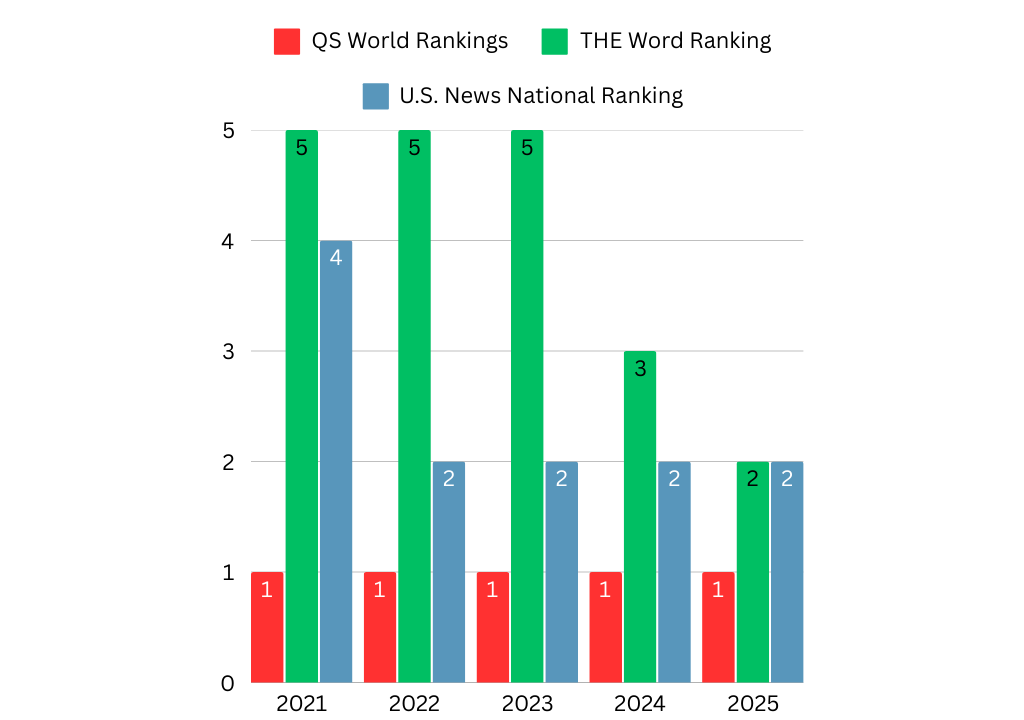
The rankings below highlight MIT’s strong presence in global education. The following illustration shows how its position has evolved over the years.
MIT has consistently maintained a dominant position in global rankings, securing the #1 spot in QS World University Rankings for five consecutive years (2021-2025), reflecting its strong academic reputation, employer perception, and research impact.
In Times Higher Education (THE) Rankings, MIT has gradually improved, moving from #5 (2021-2023) to #2 in 2025. This upward trend suggests growing recognition in research quality, faculty impact, and international outlook.
The U.S. News & World Report rankings have been stable at #2 since 2022, after a jump from #4 in 2021. This consistency highlights MIT’s sustained excellence in faculty strength, student outcomes, and global research influence.
Beyond overall rankings, MIT excels across multiple disciplines. The following section explores its subject-wise performance in 2025.
Subject-Wise Rankings of Massachusetts Institute of Technology Universities
MIT keeps its stronghold of global subject rankings, securing #1 in QS for Engineering, Computer Science, Mathematics, and Physics. It also holds #1 in THE for Business & Management, showcasing its leadership across key academic disciplines.
While MIT ranks #3 in THE for Engineering & Computer Science, its Physical Sciences (#4 in THE) and Mathematics (#3 in U.S. News) remain highly competitive.
These rankings highlight MIT’s influence in cutting-edge research, technological innovation, and business leadership. The following tables break down MIT’s subject-wise performance across QS, THE, and U.S. News.
QS Rankings 2025
The QS Rankings continue to place MIT at the top for Engineering & Technology (#1), Computer Science (#1), Mathematics (#1), and Physics (#1), reaffirming its global dominance in STEM education. The table below details MIT’s QS subject rankings for 2025.
Subject
Rankings 2025
Engineering & Technology
1
Computer Science
1
Business & Management
5
Mathematics
1
Physics & Astronomy
1
Times Higher Education (THE) Rankings 2025
The Times Higher Education (THE) Rankings highlight MIT’s #1 ranking in Business & Management, demonstrating its leadership in entrepreneurship and economic research. Its Engineering & Technology (#3) and Computer Science (#3) rankings remain among the best globally, despite strong competition.
Here’s how MIT ranks in major disciplines according to THE.
Subject
Rankings 2025
Engineering & Technology
3
Computer Science
3
Business & Management
1
Life Sciences
3
Physical Sciences
4
U.S. News Rankings 2025
MIT secures #1 in Engineering and Computer Science, while Physics ranks #1 and Mathematics #3. Business & Management stands at #5, emphasizing its strong interdisciplinary impact.
Below is MIT’s performance in key subject areas based on the latest rankings.
Subject
Rankings 2025
Engineering & Technology
1
Computer Science
1
Business & Management
5
Mathematics
3
Physics
1
MIT’s impressive subject-wise rankings reinforce its influence in shaping technological advancements, research breakthroughs, and industry-driven education.
The next section explores MIT’s standing in miscellaneous rankings for 2025.
Miscellaneous Rankings 2025
MIT's dedication to sustainability, affordability, and community engagement has earned it notable positions in various specialized rankings.
Below are MIT's standings in key areas reflecting its commitment to environmental responsibility and social impact.
Ranking Category
Description
Ranking/Recognition
Sustainability- STARS
Achieved a Gold rating with a score of 69.67 in the Sustainability Tracking, Assessment & Rating System (STARS), valid through December 16, 2024.
STARS Gold Rating
Zero Waste Initiatives
Actively participates in national competitions to promote campus waste reduction and sustainability practices.
Participant in Campus Race to Zero Waste
QS Sustainability Rankings
Ranked 33rd globally in the QS World University Rankings: Sustainability 2025, reflecting its efforts in addressing environmental and social challenges.
33
Impact Rankings 2024
Placed within the 101-200 bracket, indicating significant contributions toward the United Nations' Sustainable Development Goals.
101-200
Gender Equality Rankings
Positioned between 401-600, highlighting ongoing efforts to promote gender equality within the institution.
401-600
Reduced Inequalities Rankings 2024
Ranked 51st, showcasing initiatives aimed at reducing inequalities and fostering an inclusive environment.
51
Massachusetts Institute of Technology: Excellence and Achievements
MIT stands as a symbol of academic distinction, cultural vibrancy, and community engagement. From groundbreaking research to artistic innovation, MIT continues to set global benchmarks.
MIT's impact extends beyond traditional education, with its faculty and students earning prestigious accolades for academic excellence.
Below are some of the most significant academic recognitions that highlight MIT’s influence.
Academic Recognitions
MIT has been honored with numerous prestigious awards, reflecting its commitment to research, technological advancement, and intellectual leadership. Below are some of the institution's highest academic recognitions.
Award/Honor
Description
Nobel Prizes
MIT affiliates have received 105 Nobel Prizes, demonstrating their contributions to groundbreaking discoveries.
National Medals of Science
61 faculty members have been awarded the National Medal of Science for exceptional achievements.
National Medals of Technology and Innovation
33 MIT faculty members have been honored for pioneering innovations in technology.
These accolades showcase MIT’s dominance in shaping global scientific and technological progress.
MIT's contributions are not limited to academics. The institution fosters a thriving cultural environment, integrating artistic expression and creativity into campus life. Below are some of the most notable cultural recognitions.
Cultural Recognitions
MIT encourages artistic engagement and cultural appreciation, ensuring students develop a well-rounded perspective. Below are some of the university’s major cultural recognitions.
Recognition
Description
Arts Participation
Over half of all undergraduates enroll in arts classes each year.
Public Art Collection
MIT’s campus features over 3,500 contemporary art pieces.
MIT’s strong cultural presence reflects its dedication to fostering innovation beyond the realm of science and technology.
Beyond academic and cultural contributions, MIT is also deeply involved in community engagement and creative excellence. Below are some key initiatives that highlight this aspect.
Community & Creative Excellence
MIT’s commitment to societal impact extends beyond campus, as it actively engages in community-driven programs and innovative public initiatives. Below are some key examples.
Award/Initiative
Description
Community Service Fund
Provides financial and volunteer support to local nonprofits.
Cambridge Science Festival
Launched by the MIT Museum, promotes public engagement in STEM through hands-on activities.
MIT’s achievements extend beyond campuses, shaping global rankings and industry recognition. The next section will compare the rankings of MIT with the acceptance rate in various subjects.
MIT: Rankings vs Acceptance Rate
MIT's overall acceptance rate is approximately 4.5%, reflecting its highly competitive admissions process. The table below presents select programs, their QS World Rankings, and general acceptance rates:
Program
QS World Subject Ranking 2025
Acceptance Rate
Engineering
1
8%
Computer Science
1
6%
Business & Management
5
17.8%
These figures highlight the selectivity of MIT's top-ranked programs, underscoring the institution's commitment to academic excellence. The next section will explore the methodologies used by ranking bodies to evaluate institutions like MIT.
Ranking Bodies Methodologies
Understanding the methodologies of major university-ranking organizations provides insight into how institutions like MIT are evaluated.
Each ranking body employs specific criteria to assess universities' performance across various domains.
QS World University Rankings
The QS World University Rankings focus on academic reputation, faculty research impact, and employer reputation, making them a key measure of a university’s global influence. They also consider faculty-to-student ratio and internationalization factors like global research networks and student diversity.
These metrics highlight institutions excelling in teaching quality, employability, and research visibility.
Focus Area
Indicators
Weightage
Research and Discovery
Academic Reputation
30%
Citations per Faculty
20%
Employability and Outcomes
Employer Reputation
15%
Employment Outcomes
5%
Global Engagement
International Faculty Ratio
5%
International Research Network
5%
International Student Ratio
5%
International Student Diversity
0%
Learning Experience
Faculty Student Ratio
10%
Sustainability
Sustainability
5%
These indicators aim to provide a comprehensive evaluation of a university's global standing.
Moving on to another prominent ranking system, the Times Higher Education (THE) Rankings offer a distinct methodology for assessing universities.
Times Higher Education (THE) Rankings
THE rankings evaluate universities based on teaching quality, research environment, and research impact, making them a strong indicator of faculty and institutional excellence. Other factors like industry collaboration and international outlook ensure a well-rounded assessment.
This ranking favors universities with strong research output, academic reputation, and global engagement.
Focus Area
Indicators
Weightage
Teaching
Teaching Reputation
15%
Staff-to-student ratio
4.5%
Doctorate-to-bachelor’s ratio
2%
Doctorates-awarded-to-academic-staff ratio
5.5%
Institutional income
2.5%
Research Environment
Research reputation
18%
Research income
5.5%
Research productivity
5.5%
Research Quality
Citation impact
15%
Research strength
5%
Research excellence
5%
Research influence
5%
International Outlook
Proportion of international students
2.5%
Proportion of international staff
2.5%
International collaboration
2.5%
Industry
Industry income
2%
Patents
2%
This methodology provides a balanced assessment of universities' strengths across various domains.
Moving forward, the U.S. News & World Report Rankings offer another perspective on university evaluation.
U.S. News & World Report Rankings
The U.S. News Rankings prioritize graduation rates, faculty, and research reputation, making them a highly data-driven assessment. They also consider financial resources and student outcomes, reflecting an institution’s ability to support long-term academic and career success.
The ranking methodology encompasses several indicators, including:
Focus Indicators
Weightage
Graduation Rates
16%
First-year retention rates
5%
Graduation rate performance
10%
Pell graduation rates
5.5%
Pell graduation performance
5.5%
College grads earning more than a high school grad
5%
Borrower debt
5%
Peer assessment
20%
Financial resources
8%
Faculty salaries
8%
Full-time faculty
3%
Student-faculty ratio
4%
Standardized tests
5%
Understanding these methodologies provides clarity on how institutions like MIT are assessed across various ranking platforms.
Conclusion
MIT persists at the top in global rankings, securing the 1st spot in QS, 2nd in THE, and 2nd in U.S. News for 2025.
It leads in engineering (#1), computer science (#1), and physics (#1) across major ranking bodies, reinforcing its position as a top institution for research and innovation.
Strong placements in sustainability (#33 in QS) and reduced inequalities (#51) further highlight its commitment beyond academics. MIT’s unparalleled reputation makes it a premier choice for ambitious students worldwide.
Massachusetts Institute of Technology Rankings 2026
Disclaimer
All information provided on this page is for general use and upGrad Abroad is not responsible for any errors or omissions. Any action taken upon the information found on this website is strictly at your own risk.

 GPA CALCULATOR
 EXPENSE CALCULATOR
 Ielts band calculator
 Education Loan Calculator
 University partner
 ACCOMMODATION
 experience-center
 our offices