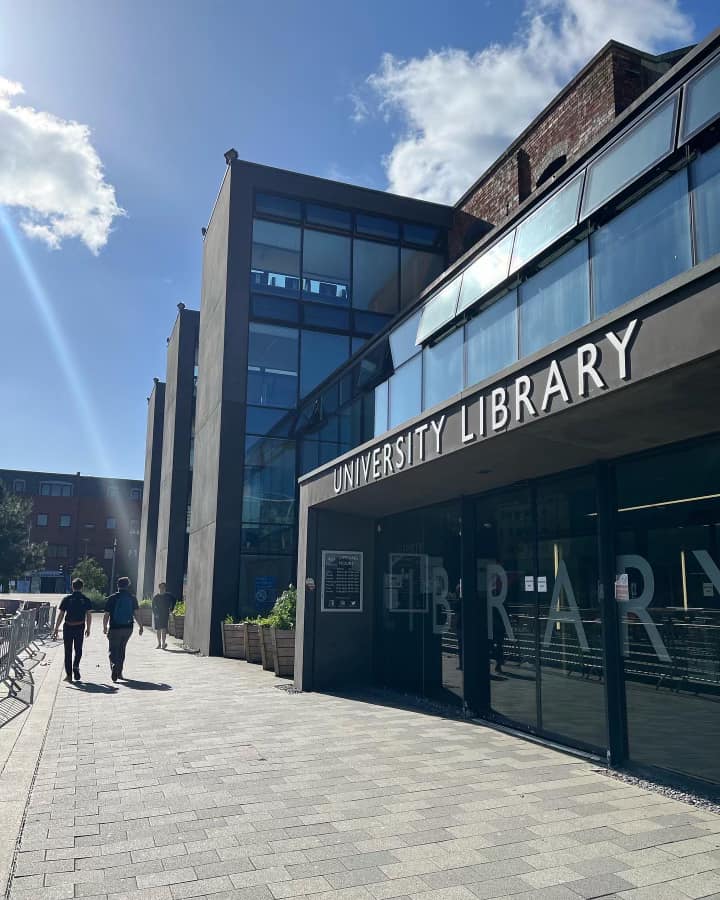
Applications for undergraduate courses starting in September 2025 are currently open.
The UCAS equal consideration deadline for most courses was 29 January 2025, but you can still apply through UCAS until 30 June 2025. Applications submitted after this date will be considered through Clearing.
University of Lincoln has rapidly established itself as a prominent institution in the UK. On the global stage, it holds a position of #851 in the QS World University Rankings 2025 and #601 in the Times Higher Education World University Rankings 2025, reflecting its growing international reputation.
The University of Lincoln's 2025 admissions are now open, offering over 150 undergraduate programmes. The university attracts a diverse student body, with 11,300 full-time and 1,400 part-time undergraduate students enrolled in the 2023/24 academic year. Its extensive alumni network comprises over 130,000 graduates living and working across 150 countries. This blog provides an overview of application deadlines, tuition, scholarships, and placement opportunities for those planning to study in UK.
Before going into specifics, the following overview table provides a clear snapshot of what prospective students can expect in terms of academic offerings, campus life, and support services.
Note: The tuition fee is calculated as the average for top courses.
Exploring your options at the University of Lincoln? If you're unsure where to begin, book a free 1:1 sessionfor support, and upGrad's advisors will guide you through courses, admissions, tuition, and scholarships.
Having covered a brief overview of the University of Lincoln, it's time to go through its programs and courses.
University of Lincoln's Fees
For international students in 2025, the average tuition fees at the University of Lincoln range from approximately £14,400 to £28,000 (INR 16.2 L to 31.5 L) per year for undergraduate programs. These fees are in line with the typical costs of the UK education system.
Postgraduate courses like MSc and MBA typically cost between £9,250 and £22,600 (INR 10.4 L to 22.6 L) annually, depending on the specialization.
Below is the list of tuition fees for some popular courses:
Course Program
Annual Tuition Fee (GBP)
Annual Tuition Fee (INR)
MSc (various specializations)
£10,400 – £19,300
INR 10 L -21.7 L
MBA / PGDM
£20,100
INR 22.6 L
MA / MPhil
£10,400 – £20,800
INR 10 L- 20.8 L
BSc (various specializations)
£14,400 – £28,000
INR 16.2 L - 31.5L
Note:
Fees may vary depending on the specialization. Please refer to the official University website for the most up-to-date information.
The currency conversions are based on the current exchange rate.
Now, let’s find out how the University of Lincoln performs in different rankings.
Scholarship
The University of Lincoln offers over 10 distinct scholarships for international students in 2025, with total awards ranging from £2K to £5K (INR 2.23L -5.6L) per year, aimed at supporting both undergraduate and postgraduate studies.
Here are some internal and external scholarships offered by the University of Lincoln:
Internal Scholarships
The University of Lincoln offers prestigious internal scholarships like the Africa Scholarship and Global Leaders Scholarship, providing significant tuition fee discounts.
These scholarships support high-achieving international students, with awards ranging from £2,000 (INR 2.23L) to 50% off tuition fees for both postgraduate and undergraduate studies.
Open to African nationals (excluding Egypt) with a conditional/unconditional offer for full-time postgraduate taught programs.
Global Leaders Scholarship
Competitive Tuition Discount
50% off tuition fees for one year
International students with offers for Sept 2025 or Jan 2026.
Must meet academic requirements (128 UCAS points or 2:1 equivalent). Not available to home fee status students.
International Undergraduate Scholarship
Automatic Tuition Discount
£2,000 (INR 2.23l) per year for undergraduate studies
Open to international undergraduate students with an offer to study full-time; no separate application needed.
Vice-Chancellor’s Scholarship
Merit-based Scholarship
Up to full tuition fee waiver for top achievers
Awarded to top international applicants demonstrating exceptional academic achievement; application required.
Apart from the university’s own scholarships, you can also look for external options based on your country of origin.
External Scholarships
In addition to the University of Lincoln's scholarships, students may also apply for external scholarships offered by governments and organizations worldwide.
These scholarships often complement university funding and provide additional financial support for international students.
Eligibility: International students from 18 eligible countries pursuing one-year postgraduate courses in the UK
Benefits: Up to £10,000 (~INR11.25 lakh) towards tuition fees, plus networking and cultural exchange opportunities.
The placement rates at the University of Lincoln reflect its outcome-based education and academic quality. Let's have a look at the placement details.
University of Lincoln's Admission
The University of Lincoln's acceptance rate is approximately 91%, reflecting a moderately selective admissions process for its diverse range of over 600 undergraduate and postgraduate programs.
The university offers multiple intakes, primarily in September and January, with applications for undergraduate courses processed via UCAS and postgraduate applications submitted directly to the university.
Below are the detailed admission requirements for studying at the University of Lincoln:
Admission Requirements
Admission requirements to study in UK, mainly at the University of Lincoln, include a minimum of 55-65% in relevant secondary or undergraduate studies, depending on the course level.
For English proficiency, applicants must meet IELTS scores ranging from 5.5 to 7.0 overall (with minimum band scores), or equivalent accepted tests such as TOEFL, Cambridge English, or the Kaplan Test of English, with specific score thresholds depending on the program.
Here’s a complete breakdown of the admission requirements:
Academic Qualification
Applicants must meet specific academic standards, with undergraduate entry requiring completion of Class XII with 65%, and postgraduate entry requiring a recognized bachelor's degree with 55-60%.
The University also offers Foundation and International Year One programs for students needing additional academic preparation before progressing to degree courses.
Below is the list of requirements:
Criteria
Details
Academic Requirements
Postgraduates: Bachelor’s degree with a minimum of 55-60% or UK equivalent 2:2 classification; some courses require 2:1 or higher.
Undergraduates: Completion of Class XII (CBSE, CISCE, or equivalent) with 55-65%
Transcripts
Official certified transcripts from previous educational institutions
The University of Lincoln requires non-native English speakers to demonstrate proficiency, typically with an overall IELTS band score of 6.0 and no band below 5.5, though some courses demand higher scores. Accepted tests include IELTS, TOEFL iBT, and PTE Academic, with equivalent minimum scores required for admission.
The University of Lincoln generally does not require standardized tests like the SAT or ACT for undergraduate admissions, focusing instead on academic qualifications and English proficiency. However, certain postgraduate programs may request GRE or GMAT scores.
Note: Requirements vary with programs. Check the official website of the university for the latest news.
Visa Requirements
International students admitted to the University of Lincoln must obtain aStudent visa for UK (formerly Tier 4) before arriving, which requires a Confirmation of Acceptance for Studies (CAS) issued by the university after paying a tuition deposit.
From January 2025, physical BRP cards have been replaced by eVisas, and students must present their visa vignette upon arrival and enrolment.
Here are the detailed visa requirements:
Document
Details
Valid Passport
Must be valid for the duration of the study and visa processing.
Issued by the University of Lincoln after offer acceptance and deposit payment; required for visa application.
Proof of Funds
Evidence of sufficient funds to cover tuition fees and living expenses as per UKVI requirements.
Biometric Information
Fingerprints and a photograph taken at the Visa Application Centre during the appointment.
Tuberculosis (TB) Test
Required for students from certain countries (e.g., Pakistan, Bangladesh).
Deposit Payment Receipt
Proof of tuition fee deposit paid to the university.
Now, let's discover the admission intakes and application deadlines for students.
Application Deadline and Intakes
The University of Lincoln offers multiple intakes primarily in September and January.
For undergraduate courses starting in September 2025, the equal consideration deadline was 29 January 2025 (Closed), but applications are still accepted through UCAS until 30 June 2025.
However, applications after this date will be considered through Clearing. Postgraduate applications are accepted year-round, with no fixed deadline, but early application is recommended.
Here are the intakes and deadlines for different levels of study:
However, before applying for admission, students should also account for living expenses such as accommodation, food, and transport. Let's take a look at these associated costs.
University of Lincoln's Acceptance Rate
University of Lincoln Acceptance Rate 2024
The university provides undergraduate and graduate programs in a wide range of specializations, such as business, education, nursing, engineering, and many more. The University of Lincoln acceptance rate is 91%. International applicants to the university must fulfill the prerequisites for both UG and PG admission.
University of Lincoln's Ranking
University rankings in UK provide valuable insight into an institution's academic quality, research impact, and global reputation.
In 2024/25, the University of Lincoln is ranked within the top 1000 globally, reflecting its growing prominence nationally and internationally, including a strong position of #70 among UK universities.
Here’s how the University of Lincoln performs across different global rankings:
Apart from overall rankings, subject-specific performance highlights the university's academic strengths in particular fields. Let’s take a look at how it performs across different disciplines.
Top Course-wise Ranking 2024/25
The University of Lincoln demonstrates strong subject-specific performance, with notable rankings in business, engineering, law, and finance.
For 2024/25, the University of Lincoln ranks between #201-250 globally for MS in Computer Science and Information Systems according to the QS World University Rankings.
In addition, it holds a global rank of #601 inArts and Humanities as per Times Higher Education (THE) and the university is also ranked #418 in Psychology by US News & World Report. These rankings demonstrate the university's diverse academic strengths across key subject areas.
Here is the subject-wise performance of the University of Lincoln:
Program
Ranking Body
Rank
Computer Science and Information Systems
QS World University Rankings
201-250
Agriculture and Forestry
QS World University Rankings
201-250
Business and Economics
Times Higher Education (THE)
301-400
Psychology
US News & World Report
418
Arts and Humanities
Times Higher Education (THE)
601
Social Science and Public Health
US News & World Report
730
Not sure if the University of Lincoln is the right fit for your higher studies? Check out the University of Lincoln Rankings 2025 to see how it compares globally and within your field!
After exploring the University of Lincoln's global rankings across different platforms, let's take a look at the admission requirements.
What career and placement opportunities does the University of Lincoln provide?
The University of Lincoln offers strong career and ensures a 96% placement rate, with 98% for MBA and 97% for MSc in Finance Management. Their Careers Service offers personalized support and access to job opportunities.
What are the entry requirements for international students at the University of Lincoln?
International students applying to the University of Lincoln must meet academic requirements such as completing a recognized high school qualification (e.g., Standard XII with 27–34 IB points or equivalent) and demonstrate English proficiency, typically with an IELTS score of 6.0 overall and no component below 5.5.
Does the University of Lincoln assist students in securing internships?
Yes, the University of Lincoln offers comprehensive support through its UoL Talent programme, which facilitates paid internships and connects students with employers across various sectors. The Careers & Employability team provides guidance on securing internships, including opportunities for virtual internships and exchanges.
How do online programs at the University of Lincoln compare to in-person courses?
Online programs at the University of Lincoln are designed to offer flexibility and support. Students can access course materials through the Blackboard virtual learning environment and receive guidance from dedicated academic tutors via email, telephone, or video conferencing. These programs are ideal for those balancing studies with professional commitments.
Is it possible to transfer from another university to the University of Lincoln?
Yes, the University of Lincoln welcomes applications from students currently enrolled at another institution. Prospective transfer students should seek guidance from their current institution, UCAS, and the University's Admissions Team. It's essential to ensure that necessary assessments are successfully completed if the offer of a place is conditional.
Are there international exchange programs available at the University of Lincoln?
Yes, the University of Lincoln offers a growing portfolio of worldwide partners for several degree programmes. Students can opt to study abroad in Europe or further afield with partner universities in countries including Canada, China, Japan, Mexico, South Africa, and the USA.
How can I enhance my chances of acceptance at the University of Lincoln?
To enhance your chances of acceptance, focus on achieving strong academic results and obtaining relevant qualifications. Engaging in extracurricular activities, gaining work experience, and demonstrating a genuine interest in your chosen field of study can also strengthen your application.
Are there application fees at the University of Lincoln?
The University of Lincoln does not charge an application fee for undergraduate admissions. Applicants can apply online using the Lincoln Admissions Application or Common Application, without incurring any cost.
What orientation programs are available at the University of Lincoln for new students?
The University of Lincoln offers comprehensive orientation programs to help new students acclimate to university life. These programs include campus tours, information sessions, and opportunities to meet faculty and fellow students, ensuring a smooth transition into university life.
What are the accommodation options for students at the University of Lincoln?
The University of Lincoln provides a range of accommodation options, including on-campus residences and private student accommodations nearby. With more than 3,700 rooms across six residences, students can choose from various room types to suit different needs and budgets.
Can I work while studying at the University of Lincoln?
Yes, international students at the University of Lincoln are permitted to work part-time during term time, typically up to 20 hours per week, depending on visa conditions. The University offers various on-campus employment opportunities, and the Careers & Employability team can assist students in finding suitable part-time work.
University of Lincoln: Rankings, Fees, Courses & Admissions
Disclaimer
All information provided on this page is for general use and upGrad Abroad is not responsible for any errors or omissions. The Universities involved in this Program are accredited/recognized in the countries where they are established. Relevant terms and conditions apply.Any action taken upon the information found on this website is strictly at your own risk.

 GPA CALCULATOR
 EXPENSE CALCULATOR
 Ielts band calculator
 Education Loan Calculator
 University partner
 ACCOMMODATION
 experience-center
 our offices